

ARUP’s Graham Dodd at Glass Performance Days 2025
At Glass Performance Days 2025, Graham Dodd of Arup gave a lecture tracing more than two decades of collaboration between Arup and our studio. Graham is a Fellow at Arup—a distinction that reflects both his technical depth and his influence within the firm—and has been a regular contributor to Glass Performance Days for many years.
At this point, Graham is probably one of the few people outside the studio who understands the work as deeply as we do ourselves. His lecture offers a rare external perspective on that shared history—one that situates individual projects within a longer arc of experimentation, trust, and mutual learning.
We first worked together nearly 25 years ago on the Berlin project with Frank Gehry. Since then, our collaboration has spanned roughly ten to fifteen projects across widely varying scales and contexts. This year's lecture featured the recently completed Manila installation, but more broadly it served as an overview of how our work together has evolved—how ideas developed, how methods were tested, and how assumptions were challenged along the way.
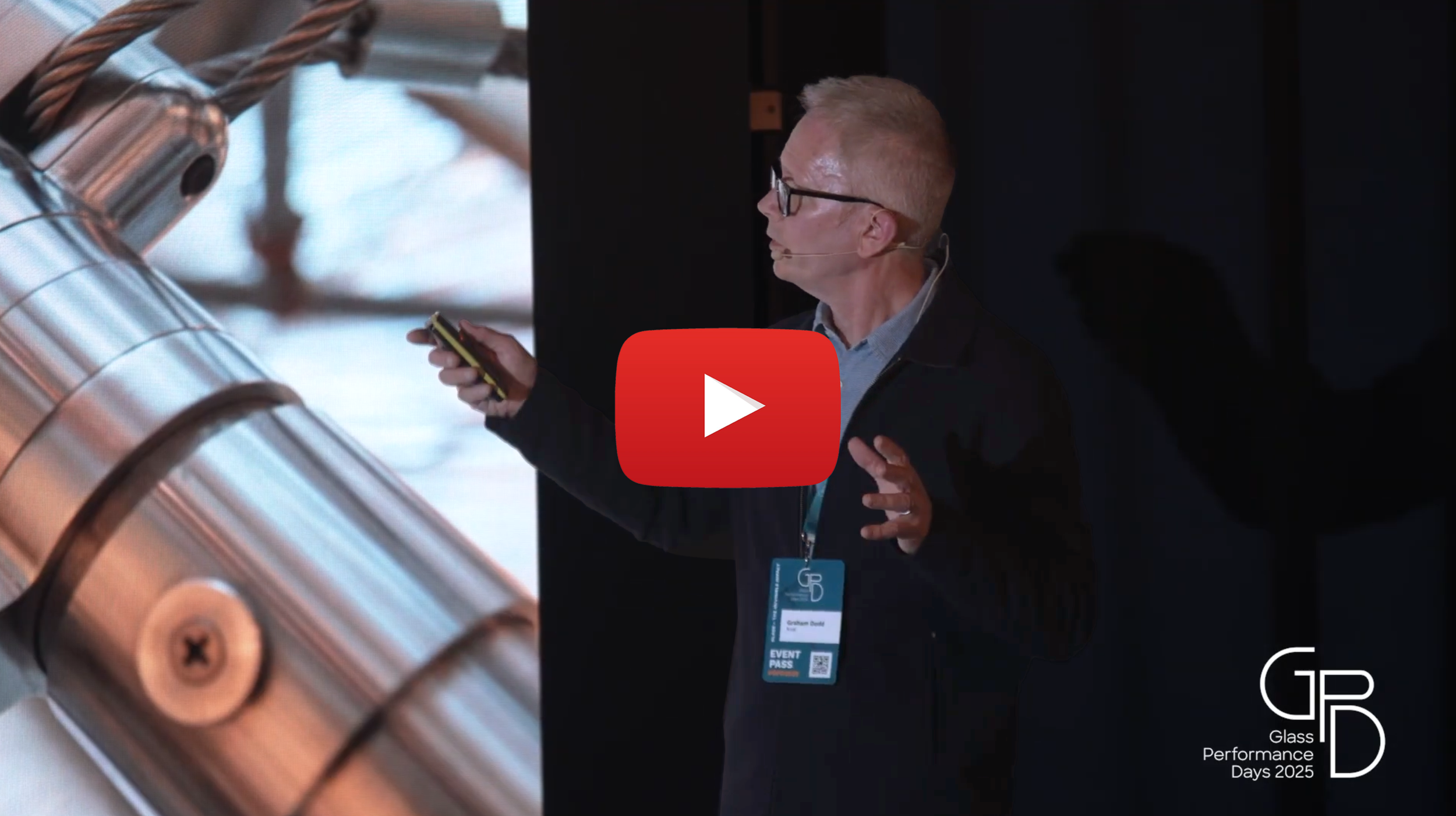
Graham is an unusually open-minded engineer, somewhat singular in his willingness to explore ideas without rigid preconceptions about what is or isn't possible. That openness has been central to our work, particularly on projects that sit outside conventional engineering or fabrication frameworks.
One of the things that makes this collaboration work is how much both sides get out of it. Our team thrives on having this professional engineering umbrella—a vast network of specialists around the world who bring deep technical history and rigorous oversight to what we're doing. It gives us confidence to push ideas further.
On their side, Arup appreciates how quick-footed and multidisciplinary we are. We'll talk through an idea on the phone, and that night someone in the studio will machine a part, print another component, run destructive testing, and then call back in the morning with feedback. That kind of rapid iteration isn't common in their world anymore—everything has become so siloed. Architects design but don't build. Testing gets sent to labs. The ability to test hypotheses in real time and see how things actually behave is rare, and members of their team find that hands-on experience genuinely exciting.
To be working with some of the top glass and engineering specialists in the world, and to have those people excited about what we're doing—that's deeply satisfying for everyone involved.